Elecrow · ESP32-C3 · 1.28" · 240×240
Elecrow CrowPanel ESP32-C3 1.28" Round Display specifications
This page collects the pinout and hardware details of the CrowPanel ESP32-C3 1.28" Round Display. The board isn't in the LCD Ultra Pro™ editor yet, so there's no driver for it there.
This is the small one in Elecrow's round lineup, and it's easy to mix up with the 1.28-inch rotary knob. Different board entirely: this one runs an ESP32-C3, a single-core RISC-V chip at 160 MHz with no PSRAM, in a flat 42 × 42 × 9.8 mm package that weighs about 15 g.
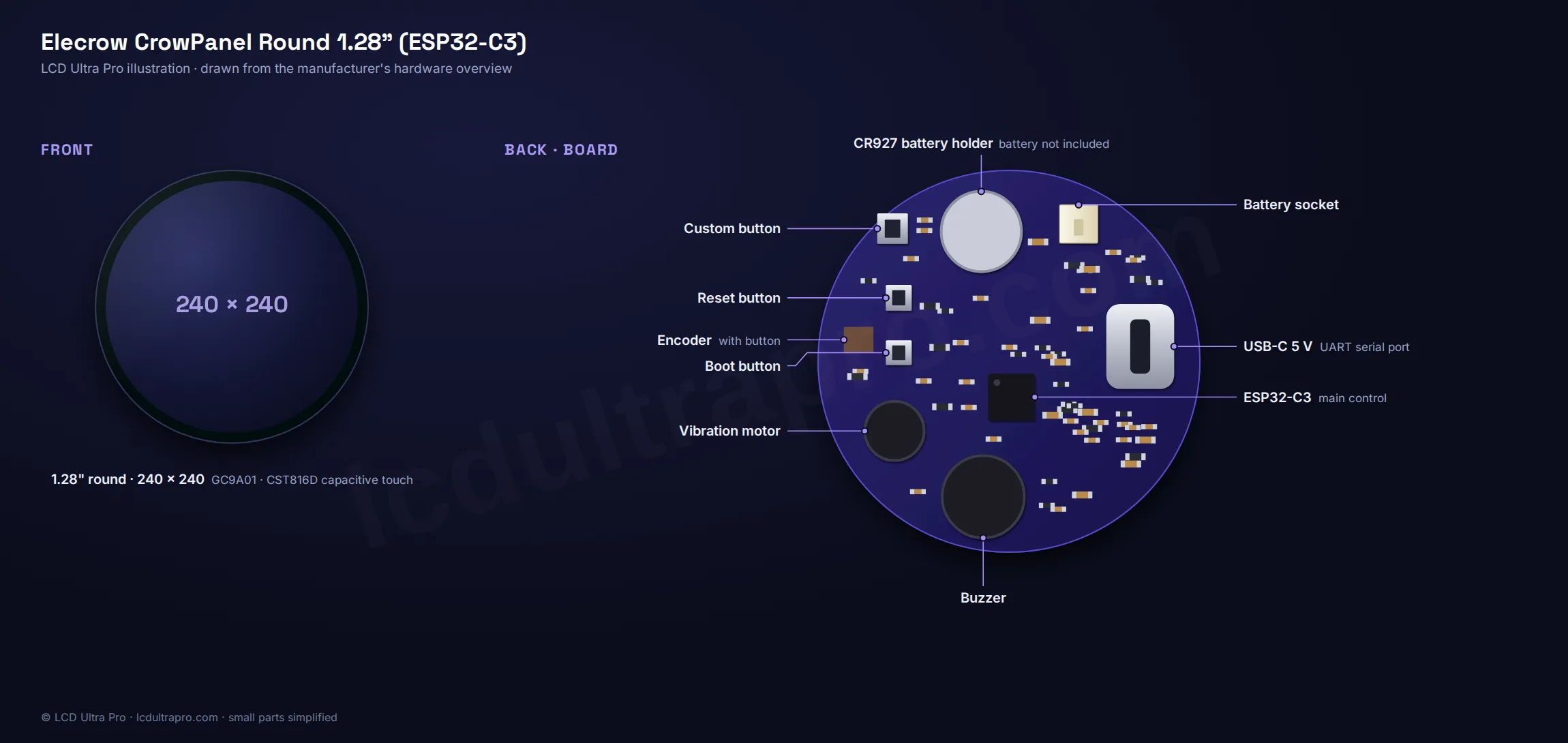
The C3 has few pins, so the design is careful with them. The GC9A01 panel uses SPI on GPIO 6/7/10 with DC on 2. Touch, a BM8563 clock and a PI4IOE5V6408 I/O expander share one I2C bus on GPIO 4/5. The expander takes over the LCD reset, the touch reset, the backlight and a small vibration motor.
Inputs are a rotary encoder (A on 19, B on 18, push on 8) and a user button on GPIO 1. There's a buzzer on GPIO 3, a coin-cell holder for the RTC and a 1.0 mm battery socket. Elecrow's wiki doesn't state the flash size. The schematic names an ESP32-C3FH4, which has 4 MB on the chip.
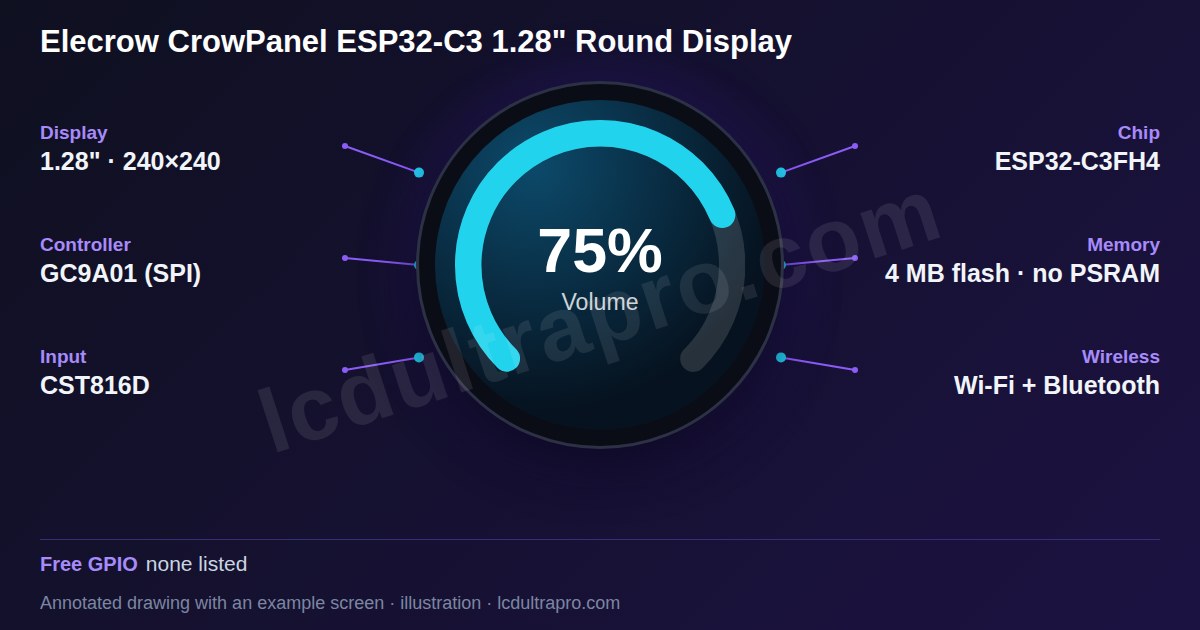
- Screen
- 1.28" · 240×240
- Chip
- ESP32-C3
- Memory
- 4 MB flash, no PSRAM
- Input
- capacitive touch
Key features
- 1.28-inch round IPS, 240×240, GC9A01
- CST816D capacitive touch
- ESP32-C3 (single core, 160 MHz)
- Rotary encoder, user button, buzzer
- Vibration motor via I/O expander
- BM8563 RTC with coin-cell holder
Specifications
| Manufacturer | Elecrow |
|---|---|
| Screen size | 1.28" |
| Resolution | 240×240 px |
| Colour depth | 16-bit |
| Display controller | GC9A01 (SPI) |
| Display interface | SPI |
| Touch | CST816D (capacitive, I2C 0x15) |
| Rotary encoder | Yes |
| Microcontroller | ESP32-C3 |
| Module | ESP32-C3FH4 (4 MB in-package flash) |
| CPU clock | 160 MHz |
| Internal SRAM | 400 KB |
| PSRAM | None |
| Flash | 4 MB |
| Wi-Fi | Yes |
| Bluetooth | Yes |
| Hardware variant | Hardware V1.0 schematic (Elecrow, 2024-05-07), which names an ESP32-C3FH4 (4 MB flash inside the chip). LCD reset, touch reset, backlight and the vibration motor sit on a PI4IOE5V6408 I/O expander (I2C 0x43). BM8563 real-time clock with a CR927 coin-cell holder. |
| Display | 1.28-inch round IPS, 240×240, GC9A01 (SPI: SCK 6, MOSI 7, CS 10, DC 2), 350 cd/m² |
| Touch | CST816D at 0x15, I2C GPIO 4/5, INT GPIO 0 |
| I/O expander | PI4IOE5V6408 at 0x43: LCD reset, touch reset, backlight, vibration motor |
| Inputs | Encoder A 19, B 18, push 8; user button GPIO 1 |
| Extras | Buzzer GPIO 3, BM8563 RTC, CR927 holder, SH1.0 battery socket |
| Size | 42 × 42 × 9.8 mm, 15 g |
Board layout and connectors
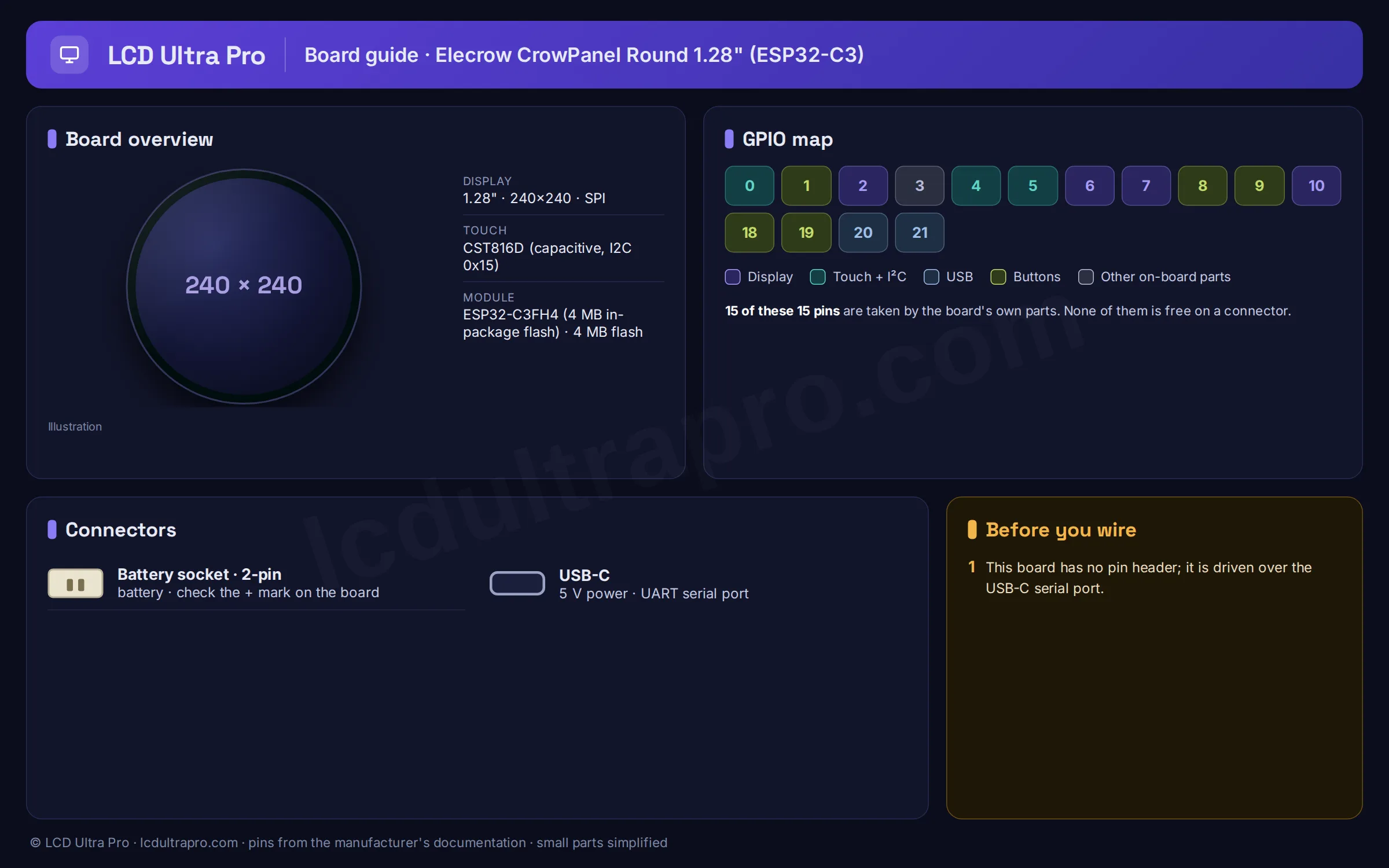
Where each connector, button and LED sits on the Elecrow CrowPanel ESP32-C3 1.28-inch Round Display, with the pin order next to each header where the manufacturer confirms it. We drew it from the manufacturer’s own photos and board documentation. The tiny parts are simplified.
GPIO pinout
The GPIOs the board itself uses for the display, touch and on-board peripherals, as published in the manufacturer’s documentation.
| GPIO | Function |
|---|---|
| GPIO 0 | Touch interrupt |
| GPIO 1 | User button |
| GPIO 2 | LCD DC |
| GPIO 3 | Buzzer |
| GPIO 4 | I2C SDA (touch, RTC, I/O expander) |
| GPIO 5 | I2C SCL (touch, RTC, I/O expander) |
| GPIO 6 | LCD SCK |
| GPIO 7 | LCD MOSI |
| GPIO 8 | Encoder push button |
| GPIO 9 | BOOT button |
| GPIO 10 | LCD CS |
| GPIO 18 | Encoder B |
| GPIO 19 | Encoder A |
| GPIO 20 | UART0 RX (USB serial) |
| GPIO 21 | UART0 TX (USB serial) |
Source: github.com, www.elecrow.com, www.elecrow.com. Always check against your board revision before wiring.
Free GPIOs and connectors
This board has no free GPIOs: every pin is used by the display, touch or on-board peripherals.
Good to know before you start
- The LCD Ultra Pro editor doesn't offer this board yet.
- No PSRAM. Keep LVGL buffers small and skip full-screen images.
- The backlight won't come on until you set the expander pin. Elecrow's MicroPython LCD example shows how.
- All GPIOs are in use. Extra parts have to go on the I2C bus.
What it is good for
- •Wearable-sized dials and timers
- •Haptic notifiers with the vibration motor
- •Small clocks that keep time on a coin cell
LVGL support in LCD Ultra Pro™
This board is documented in the wiki, but it is not in the LCD Ultra Pro™ editor yet, so you can’t pick it there or export a project for it. The specs, pins and connectors on this page come from the manufacturer’s own material and are there to help you wire and configure it. See the board list for boards the editor supports today.
Arduino IDE settings
From the manufacturer's documentation (not tested by us yet)
| Board | ESP32C3 Dev Module |
|---|
Board package: esp32 by Espressif Systems
Menu items the manufacturer doesn't mention are left at their defaults. We haven't compiled a driver for this board ourselves yet. Manufacturer's source
Frequently asked questions
Is this the same as the CrowPanel 1.28-inch rotary knob?
No. The knob has an ESP32-S3 with PSRAM and an LED ring. This round display uses an ESP32-C3 without PSRAM.
How do I turn on the backlight?
Through the PI4IOE5V6408 I/O expander at I2C address 0x43. LCD reset and backlight are pins on that chip, not ESP32 GPIOs.
Does it support MicroPython?
Yes. Elecrow ships MicroPython firmware and examples for the LCD, touch, encoder, buzzer and RTC.
Sources
Specifications cross-checked against the manufacturer’s documentation (last checked 2026-11-04):
- https://github.com/Elecrow-RD/CrowPanel-ESP32-1.28-inch-Round-Display
- https://www.elecrow.com/wiki/CrowPanel_ESP32_1.28-inch_Round_Display.html
- https://www.elecrow.com/crowpanel-esp32-display-1-28-r-inch-240-240-round-ips-display-capacitive-touch-spi-screen.html
- https://www.elecrow.com/wiki/ESP32_1.28-inch_Round_Display_Tutorial.html
More in the Elecrow CrowPanel family
- Elecrow CrowPanel 1.28" ESP32-S3 Round Rotary Display
- Elecrow CrowPanel 1.46" ESP32-S3 Round Rotary Display
- Elecrow CrowPanel 2.01" ESP32-S3 Watch Display
- Elecrow CrowPanel 2.1" ESP32-S3 Round Rotary Display
- Elecrow CrowPanel Advance 2.4" ESP32-S3 HMI
- Elecrow CrowPanel ESP32 HMI 2.4"
- Elecrow CrowPanel Advance 2.8" ESP32-S3 HMI
- Elecrow CrowPanel ESP32 HMI 2.8"
- Elecrow CrowPanel Advance 3.5" ESP32-S3 HMI
- Elecrow CrowPanel ESP32 HMI 3.5"
- Elecrow ESP Terminal 3.5" 16-bit Parallel
- Elecrow ESP Terminal 3.5" SPI with Camera
- Elecrow CrowPanel Advance 4.3" ESP32-S3 HMI
- Elecrow CrowPanel ESP32-S3 HMI 4.3"
- Elecrow CrowPanel Advance 5.0" ESP32-S3 HMI
- Elecrow CrowPanel Advanced 5" ESP32-P4 HMI
- Elecrow CrowPanel ESP32-S3 HMI 5.0"
- Elecrow CrowPanel Advance 7.0" ESP32-S3 HMI
- Elecrow CrowPanel Advanced 7" ESP32-P4 HMI
- Elecrow CrowPanel ESP32-S3 HMI 7.0"
- Elecrow CrowPanel Advanced 9" ESP32-P4 HMI
- Elecrow CrowPanel Advanced 10.1" ESP32-P4 HMI
Tools for this board
- CrowPanel ESP32-C3 1.28" Round Display Arduino IDE settings
- CrowPanel ESP32-C3 1.28" Round Display side-by-side comparison
- CrowPanel ESP32-C3 1.28" Round Display LVGL memory estimate
- CrowPanel ESP32-C3 1.28" Round Display I2C address check
- Other ESP32 boards with the GC9A01
- Find similar ESP32 display boards
Connect sensors and parts
- 28BYJ-48 stepper
- A4988 stepper driver
- ACS712 current sensor
- ADS1115 ADC
- ADXL345 accelerometer
- AHT20
- AS5600 magnetic encoder
- BH1750
- BME280
- BME680
- BMP280
- BTS7960 motor driver
- CAN bus (SN65HVD230)
- Capacitive soil moisture
- DFPlayer Mini
- DHT22 / AM2302
- DS18B20
- DS3231 RTC
- EC11 rotary encoder
- ENS160
- HC-SR04
- HC-SR501 PIR
- HX711 load cell
- INA219
- INA226
- INMP441 microphone
- IRLZ44N MOSFET
- KY-023 joystick
- 4x4 matrix keypad
- LD2410 radar
- LDR photoresistor
- MAX31855 thermocouple
- MAX7219 LED matrix
- MAX98357A I2S amp
- MCP23017 GPIO expander
- microSD card
- MLX90614 IR thermometer
- MPU6050
- MQ-2 gas sensor
- NEO-6M GPS
- NTC thermistor 10k
- PCA9685 PWM driver
- Piezo buzzer
- Push button
- PZEM-004T
- RC522 RFID
- 5 V relay module
- RS-485 (MAX3485)
- SCD40
- SG90 servo
- SHT31 / SHT3x
- SIM800L GSM
- SSD1306 OLED
- SSR-40DA relay
- LoRa SX1276
- TB6612FNG motor driver
- TCS34725 colour sensor
- TP4056 battery charger
- TTP223 touch button
- VL53L0X
- WS2812B LED strip
- YF-S201 flow sensor
Last updated:
Adding I2C sensors to this board?See which addresses its own chips already use, and what would clash.Open the checkerSomething wrong on this page?
Tell me what you found. I check every report and fix the page.